It’s funny how we all have a tendency to picture the orbits of planets as being circular. That’s how we see it in diagrams and how we usually draw it in pictures. After all, circles seem perfect… they seem natural.

This bias in favour of circular motion was held even more strongly in the 17th century, when planets were seen as heavenly bodies whose orbits must reflect a perfect shape, like a circle. Then, in 1609, a German astronomer, Johannes Kepler, came along and published his Astronomia Nova, stating that planets did not, in fact, orbit the sun in circles.
Kepler discovered three laws which seemed to govern the way planets orbit the sun:
The 1st Law of Planetary Motion: each planet’s orbit around the sun is an ellipse, the sun being one focus.
(An ellipse is a shape with two focal points. The sum of the distance between a point on its circumference and the two focal points is constant.)
This was a discovery that no one had really anticipated before him. While the heliocentric model had already been proposed by Copernicus, and by Aristarchus before him, the idea that planets did not move in circles or epicycles was a new one which was rather difficult to comprehend at the time.
The 2nd Law of Planetary Motion: If an imaginary line joined a planet and the sun, that line would cover equal areas in equal amounts of time. Therefore, a planet moves fastest when it’s nearest to the sun. And slowest when it’s farthest away.
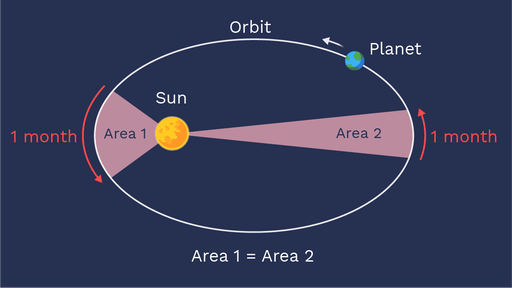
This was another concept with challenged the idea of planets being perfect heavenly bodies, since perfect movement involved a constant speed… no one would’ve thought planets raced at some point in their orbit and dawdled in another.
The 3rd Law of Planetary Motion: The period of a planet’s orbit (P) squared, is proportional to the size of it’s orbit (a) cubed, or in more mathematical terms:
P^2 = k (a^3)
This law was published a decade later than the first two, and indicated there was a proportionality between how far away a planet was from the sun and how long its year was.
————————————————-
Kepler’s discoveries seemed to reveal that planets were not these perfect, heavenly bodies which people had thought them to be. They show us that nature is under no obligation to abide by our aesthetic tastes. In my opinion, that just makes it all the more beautiful…
 The Ultimate Nerd Book
Leave a comment